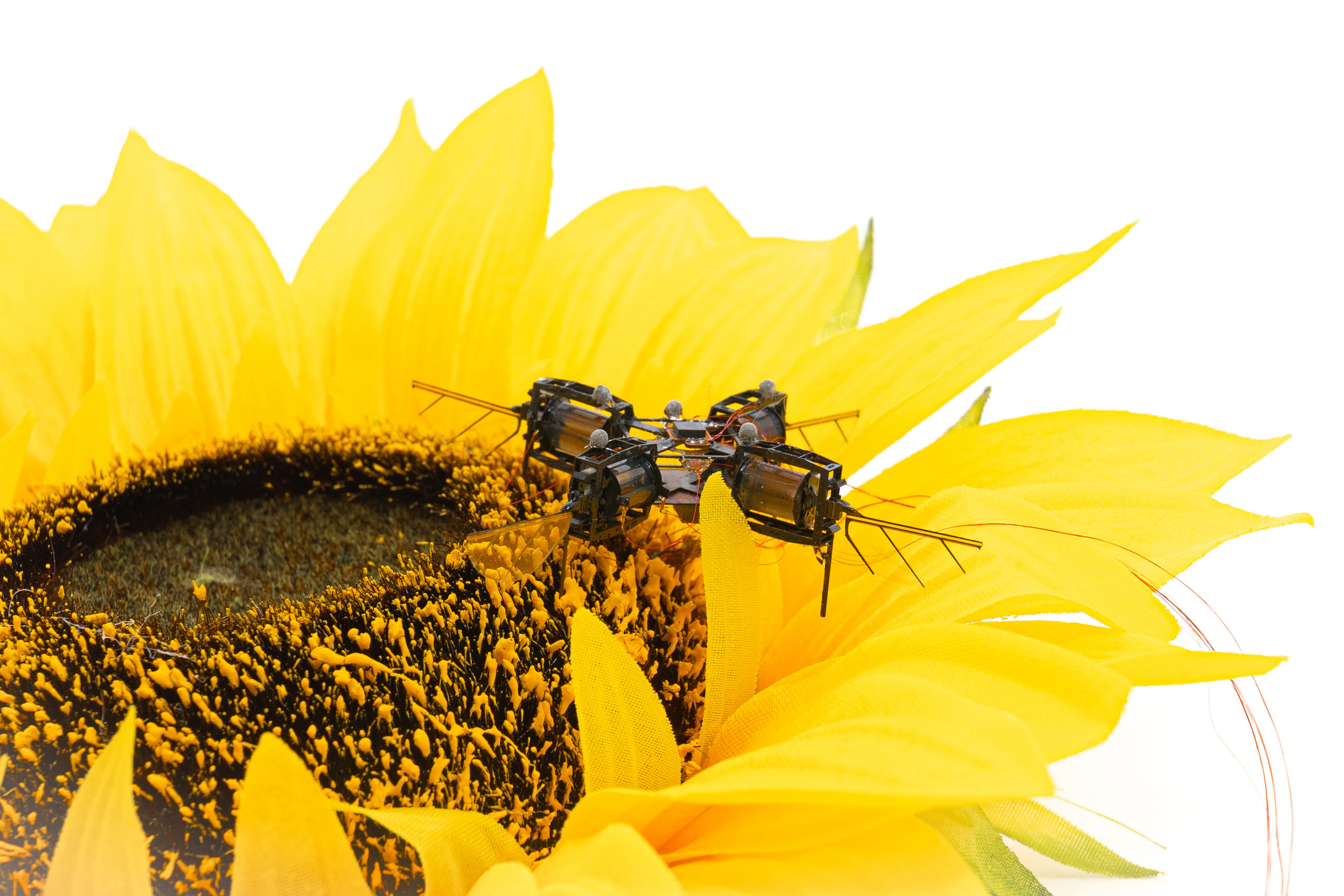
Most tiny flying robots are tethered, not to a wire, but to a lab full of motion-capture cameras that tell them where they are. MIT researchers have cut that cord. Their new flapping-wing microrobot carries its own sensors and computation, and can follow a complex trajectory and land precisely on a sunflower outside the motion-capture setup, according to MIT News.
The weight problem
The team achieved a lift-to-weight ratio of 1.9, giving the robot enough lift to carry an onboard electronics package that weighs just 244 milligrams. That package holds the sensors and the microcontroller needed for onboard sensing and computation.
"This is a really important milestone for the research community. This is the first demonstration of an aerial microrobot that is sensory and compute autonomous," says Kevin Chen.
What it could lead to
MIT says the work moves such robots closer to applications like agriculture or industrial surveillance. It is a lab demonstration, not a product, and the article does not give a commercialization timeline.
Why it matters: Autonomy at insect scale is a hardware story as much as an AI one: every milligram of battery, sensor and chip is a trade-off. It is a reminder that the next wave of tech careers will sit where robotics, embedded systems and machine learning meet. Source: MIT News.